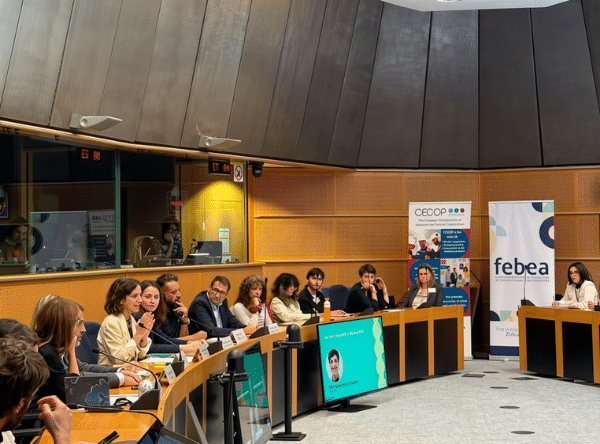
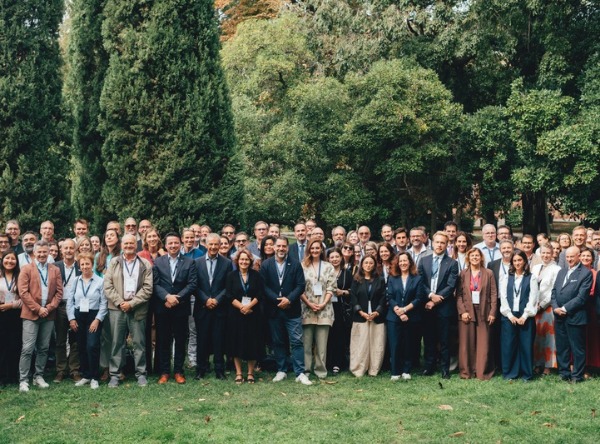
From 23 to 25 September, Venice became a meeting point for Europe’s ethical finance community, as around 200 representatives from ethical-finance institutions across 22 European countries came together for FEBEA’s 25th Annual Conference.
Hosted by one of FEBEA’s oldest members, Banca Etica, the three-day gathering explored this year’s theme, “Caring and Preserving: Ethical Finance Building Community.” Through workshops, keynote speeches, public debates, governance sessions, member initiatives and peer exchanges, participants shared experiences, learned about the ecosystem and its roots and explored new opportunities for cooperation.
Over three days, participants explored the idea of ethical finance as an ecosystem: a diverse network in which local financiers, social-economy organisations, civil society, public institutions and international partners contribute different resources and capabilities towards a common purpose.
The gathering brought together FEBEA members and representatives of organisations including the European Commission, the European Investment Bank (EIB), European Investment Fund (EIF), Council of Europe Development Bank (CEB), Social Economy Europe (SEE), Global Social Economy Forum (GSEF), Global Alliance for Banking on Values (GABV) and Institute for Social Banking (ISB), Frankfurt School of Finance & Management (SIFTA), REScoop, MEDWAVES, UNCDF, Global Summud Flotilla, Legacoop, Stop Killer Robots, ICAN or CNEL – Consiglio Nazionale Economia e Lavoro and many others.
The conference opened on 23 September at Palazzo Pisani with “Ethical Finance Building Community Beyond Borders,” an event organised by Banca Etica and GLS Bank. The discussion examined the work of organisations supporting migrants and refugees along the Mediterranean and Balkan routes—and the responsibility of financial institutions to help sustain that work.
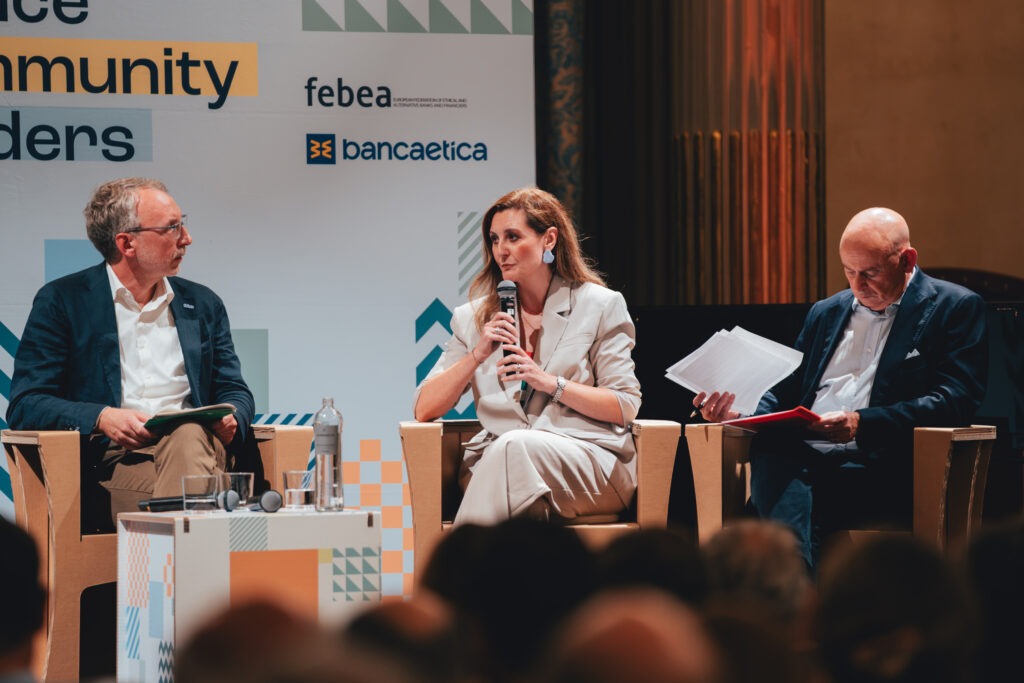
Journalist Eleonora Camilli moderated the evening. Opening contributions came from Federica Ielasi, Vice-President of Banca Etica; Banca Etica’s local associates’ group; and Diego Saccora, Vice-President of Lungo La Rotta Balcanica.
The realities of reception and integration were presented by Ettore Mazzanti, President of Médecins Sans Frontières; Giovanni Schiavone, President of Consorzio Italiano di Solidarietà; Till Rummenhohl, General Director of SOS Humanity; and Massimo Pallottino, Head of Studies and Advocacy at Caritas Italiana.
A second discussion brought together Roberta Conte, President of Banca Etica’s Executive Committee; Stefan Möller, Regional Manager at GLS Bank; Eleni Bletsa, Head of Sustainable Development and Strategic Partnerships at the Cooperative Bank of Karditsa; and Bruno Robino, Deputy Head of the Advisory Financial Institutions Division at the EIB.
One message connected the different interventions: organisations working at Europe’s borders cannot respond to humanitarian needs alone. Ethical banks can provide patient financing and close relationships, while institutions such as the EIB can contribute resources, expertise and instruments that expand their capacity. Building community beyond borders therefore requires an ecosystem based on trust, human dignity and shared responsibility.
The second day began with a General Assembly full of strategic and practical content. Alongside FEBEA’s governance decisions, institutional partners and members shared tools, projects and opportunities for collaboration.
The Assembly heard presentations of initiatives led by members including Bruno Dunkel of Inpulse, Miguel Linde of Fundació Seira, Eleni Bletsa of the Cooperative Bank of Karditsa, Timo Hülsdünker and Stefan Möller of GLS and Federica Ielasi of Banca Etica. New partnerships and collaborations were also presented, including a new project with MedWaves and the preliminary results of a market study with the EIB. These examples showed the breadth of work within FEBEA, from investment and guarantee instruments to cooperative finance, social innovation and place-based development.
A particularly important moment was the signing of a new agreement between GLS and the European Investment Fund. The agreement demonstrated how relationships cultivated through the FEBEA ecosystem can lead to concrete financial cooperation.
Members also explored the newly created FEBEA Marketplace, designed to facilitate structured cooperation based on members’ financing capacity and the demand for investment within the network. In the words of incoming President Panagiotis Tournavitis, the Marketplace showed what becomes possible “when we stop thinking of ourselves as independent institutions and start thinking of ourselves as one balance sheet of values.”
In parallel, Venice also brought together the next generation of ethical finance through FEBEA’s third Youth Encounter around Ethical Finance. Young participants from the European Youth for Ethical Finance (EYEF), the recently established youth group bringing together the youth of FEBEA and its members, focused on strengthening their network and shaping a roadmap for its future activities.

The encounter also created space to explore how EYEF can build the resources needed to grow its work. During a SIFTA workshop on funding opportunities, participants co-created a project proposal aimed at securing funding to support EYEF’s activities, promote ethical finance among young people and foster intergenerational renewal across FEBEA’s membership.
The day also offered an opportunity to connect the experience of different generations of the movement. In a discussion with former FEBEA President Peru Sasia, who served as President for more than nine years, young participants reflected on the evolution of ethical finance, shared their concerns about the future and drew on his experience and lessons from the network.
The message was clear: the future of ethical finance depends not only on passing on experience, but also on creating the space for new generations to shape what comes next. As FEBEA President Panagiotis Tournavitis put it in his closing address: “The third Youth Encounter is proof that this is not a movement of one generation. It has heirs. Our job is to make sure they inherit something worth keeping.”
The General Assembly also marked an important moment for FEBEA’s governance, with the election of a new Board of Directors. The newly elected Board subsequently appointed Panagiotis Tournavitis of the Cooperative Bank of Karditsa as FEBEA’s new President and Andrea Baranes of Banca Etica as Vice-President.
They new Board of Directors is formed by:
The new leadership reflects the diversity of FEBEA itself: banks, cooperatives, funds and alternative financiers working in different national contexts but united by a value-based approach to finance.
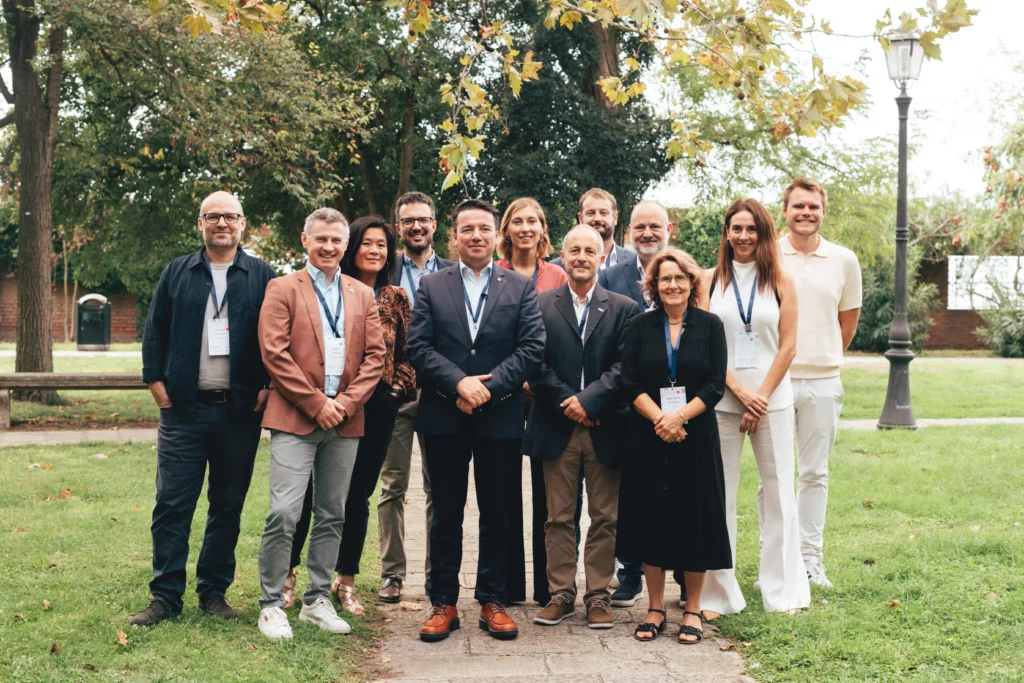
The afternoon workshops created space to move from institutional discussion to practical cooperation.
The Financial Opportunities sessions brought FEBEA members together with the EIB, CEB and EIF, creating a space to explore concrete opportunities for cooperation and how European resources can better support ethical finance and the social economy.
Participants explored SIFTA advisory services, with an overview of the support provided by the Frankfurt School of Finance & Management, a practical case study and an introduction to the evaluation services offered by MFR. The session offered members a closer look at the technical support available to help strengthen their work and access to European resources.
The discussion then turned to how European financial resources can better reach and support the social economy. Current cooperation between the CEB and FEBEA members provided concrete examples of how these partnerships can work in practice, while the exchange with the EIB offered space to explore opportunities for further cooperation.
The final session focused on FEBEA members’ cooperation with the EIF. Members shared direct feedback on current operations, discussed possible future scenarios and explored ways to further improve the collaboration. Across the sessions, one message stood out: public resources work best when guarantees, financing and technical assistance are combined with the local knowledge and experience of ethical-finance institutions.
The FEBEA Marketplace then explored ways to structure internal financial cooperation between members. Its central idea was simple but potentially transformative: the network’s different lending and investment capacities can complement one another, allowing members to develop transactions that would be difficult to undertake individually. The session marked a step towards co-creating a genuine Financial Marketplace, shaped by the needs, experience and vision of FEBEA members themselves.
The Participation in Ethical Finance workshop, organised by Banca Etica, drew on the bank’s own participation model to open a broader dialogue on what participation means in ethical finance. Representatives of Hefboom, Cassa Centrale Banca, AICCON, Sustainable Public Affairs, Genossenschaft für Gemeinwohl, Inpulse Investment Manager, Philea, Sociálni Inovátori, La Nef, Crédit Coopératif, vdk bank and Favafond. Participants illustrated their understanding of participation before discussing their reflections in small groups and sharing the main ideas in a plenary session.
The engaging discussion addressed inclusion, accountability, conflict, bridge-building, technology, new generations and the importance of adopting a systemic perspective. It highlighted participation not simply as a governance mechanism, but as an ongoing process of dialogue and collective responsibility.
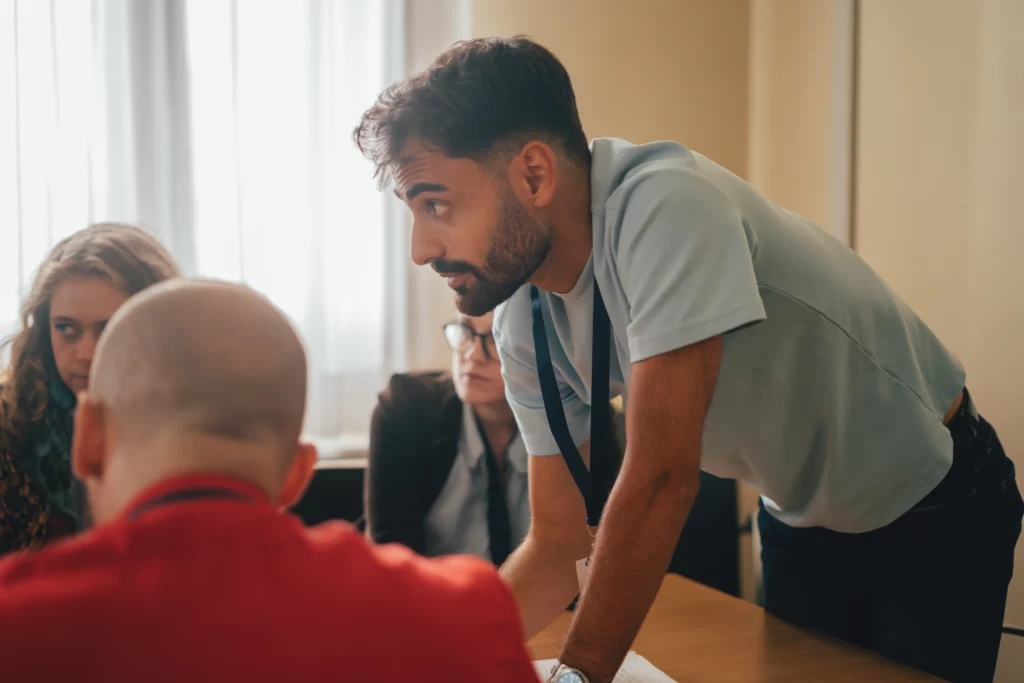
The Advocacy and Outreach workshop focused on strengthening the link between national advocacy efforts and FEBEA’s work at European level, with a particular focus on the new Multiannual Financial Framework (MFF) and its role in shaping a solid European social investment infrastructure. Participants explored the current legislative process around the new MFF architecture, looking at its key elements, technical aspects and potential implications. The discussion then moved from policy to practice, with members exploring advocacy tools that can be adapted to different national and political contexts, while working towards a shared message on the role of ethical finance and the social economy in strengthening Europe’s resilience and competitiveness.
Finally, the EYEF workshop aimed at fostering the autonomy and the capacity of the group, by exploring funding opportunities to develop sustainable resources for future activities. The sessions introduced young participants to a range of relevant European funding programmes and provided practical guidance on the different stages and requirements of the application process. Building on this knowledge, participants worked collaboratively to co-create draft project proposals for each of the EYEF working groups: Education, focused on promoting financial literacy and raising awareness of ethical finance; Collaboration, aimed at strengthening partnerships with other youth organisations and groups within the social economy; and Impact, dedicated to collecting data and developing databases to better understand the needs of ethical banks in relation to young people, as well as young people’s needs and expectations regarding finance and, more specifically, ethical finance. The workshop therefore marked the beginning of a practical process of developing project ideas into concrete funding proposals. By combining knowledge of European funding opportunities with collaborative project development, the aim was to equip the EYEF network with the tools needed to secure financial support and sustain its activities in the longer term.
After the workshops, participants visited the San Servolo museum and took part in a basketball game that, as some said, was played with more enthusiasm than skill. The informal moments mattered too: they strengthened the personal relationships on which cooperation within the federation ultimately depends.
The public conference on 25 September was opened by Aldo Soldi, President of Banca Etica, and Pedro “Peru” Sasia Santos, in his final public appearance at an Annual Conference as President of FEBEA.
Sasia’s contribution marked the end of nine years at the head of the federation. During his presidency, FEBEA reinforced its role as a collective European voice and a trusted partner for institutions working to finance the social economy.
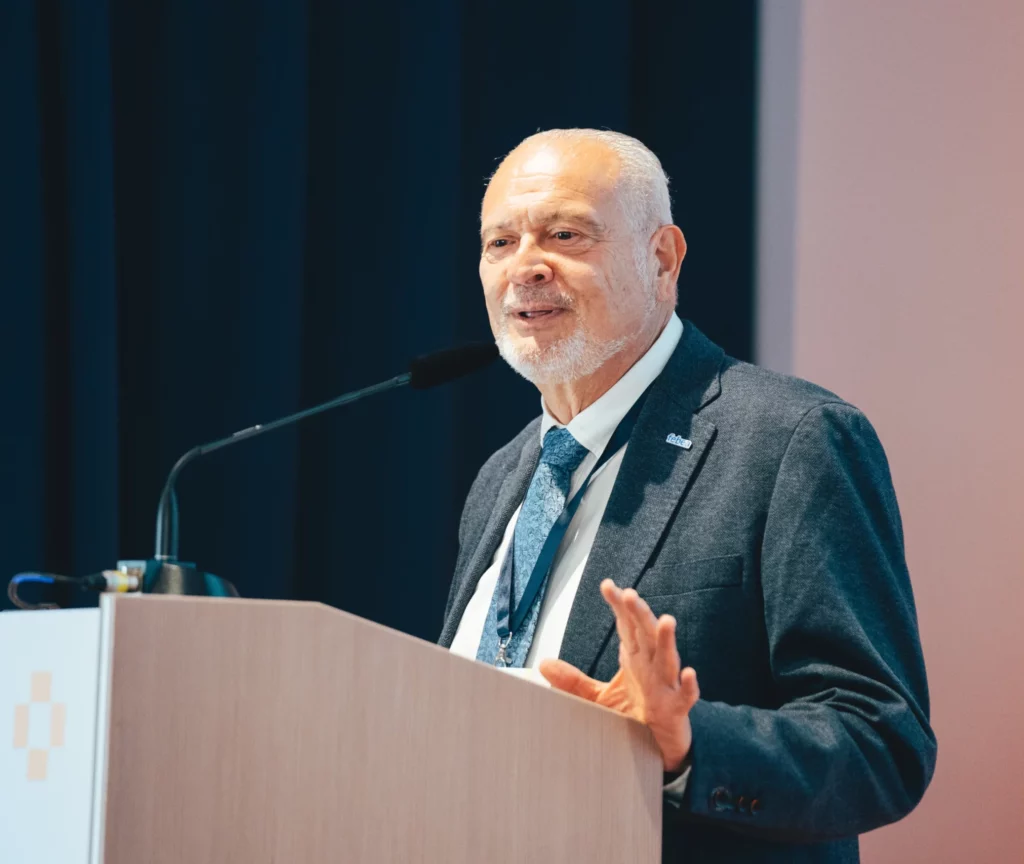
Looking back on the evolution of the ethical finance movement, Sasia emphasised that its ambition must go beyond simply surviving as an alternative to conventional finance. “In the actual context, ethical finance is much more than an effort to survive as a counter-cultural proposal,” he said. “We have understood during these 25 years of existence that we have the responsibility to lead a different way of doing finances, a way that places the focus on caring, preserving, creating prosperity without building walls or hurting the planet.” As he brought his presidency to a close, these words served not only as a reflection on the journey so far, but also as a call to carry this responsibility forward and continue building a financial system centred on care, inclusion and the wellbeing of people and the planet.
Soldi welcomed participants on behalf of Banca Etica, whose role as host extended beyond logistics. Its participatory structure, local member groups and wider group of organisations offered a practical example of how diversity and stakeholder involvement can strengthen an ethical-finance institution.
The institutional opening also included a video message from Mario Nava, Director-General for Employment, Social Affairs and Inclusion at the European Commission. Later in the programme, Nadia Calviño, President of the EIB, addressed participants by video.
Ruth Paserman, Director at the European Commission’s Directorate-General for Employment, Social Affairs and Inclusion, underlined that ethical finance has proved both its European relevance and its financial robustness. Her key message was that ethical finance combines “purpose and patience”: it can achieve financial resilience while supporting social and environmental objectives that require long-term commitment.
Paserman described ecosystems as structures in which policy and finance are connected through relationships that generate trust and, eventually, transactions that improve people’s lives. Ethical-finance institutions, she argued, are therefore natural partners for implementing Europe’s social priorities.
Sandrine Gaudin, Vice-Governor for Financial Strategy at the CEB, structured her intervention around four ideas: scale, proximity, partnership and impact. Europe needs to mobilise more capital for social priorities, but scale is meaningful only if financing reaches the communities where it is needed.
FEBEA members bring proximity and local knowledge that larger institutions cannot easily replicate. Development banks and EU programmes can contribute scale, guarantees and risk capacity. Their cooperation can connect European resources with local realities—and impact measurement can demonstrate results, build confidence and attract further investment.
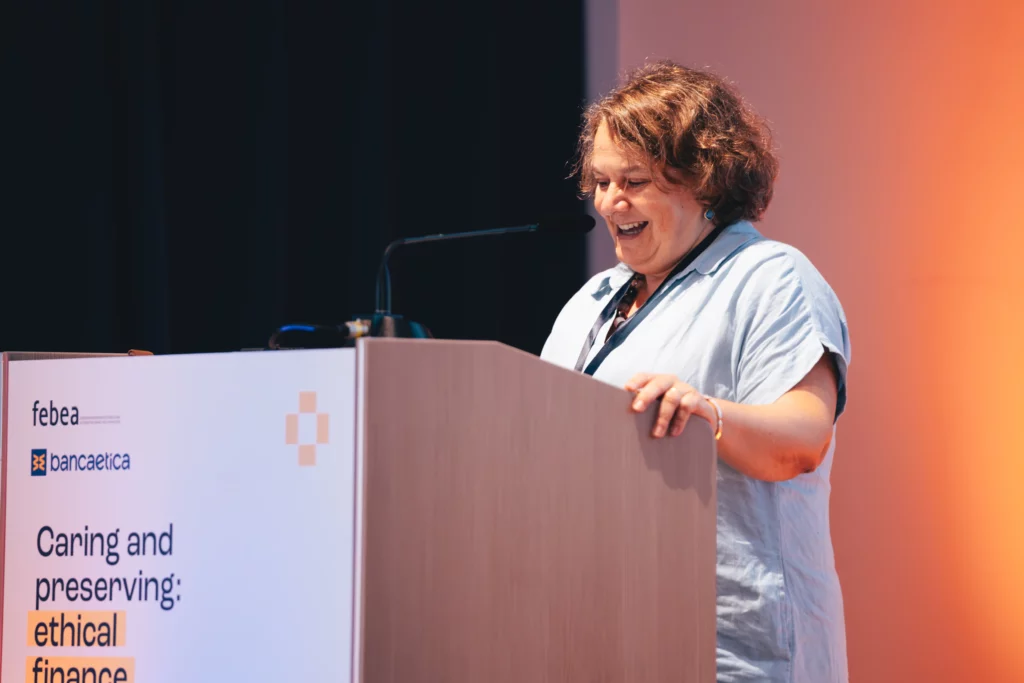
Science communicator and environmental expert Alessandra Viola invited the audience to “think like a plant.” In her own words: “Plants and natural ecosystems survive not through domination but through cooperation, adaptation and networks that share resources. The same lesson applies to ethical finance: diversity makes an ecosystem resilient, provided that its different actors cooperate rather than compete for control”.
Together, these interventions offered complementary perspectives on the role of ethical finance in building a more resilient and inclusive European financial ecosystem: from the importance of long-term purpose and trust, to the value of proximity and partnerships, and ultimately to the power of cooperation and diversity. These reflections were followed by the Banca Etica and FEBEA panels, which brought the discussion back to practice, offering concrete examples of the relationships, partnerships and collaborations that already sustain this ecosystem.
The first part of the Banca Etica and Etica Sgr panel examined alliances for local development. Moderated by Federica Ielasi, Vice-President of Banca Etica, it featured Paola Bellotti of Coopfond and Ismael Medina Claros of FAECTA.
Their discussion showed that ethical finance is most effective when it is part of a broader territorial ecosystem. Financial institutions, cooperative networks and local organisations must work together to build instruments that respond to the real needs of communities rather than imposing standard solutions from outside.
The second part, on global coalitions for peace, was moderated by Aldo Bonati, Stewardship and ESG Networks Manager at Etica Sgr. It brought together Susi Snyder of the International Campaign to Abolish Nuclear Weapons (ICAN) and Roos Boer of Stop Killer Robots, with conclusions from Marco Carlizzi, President of Etica Sgr.
At the heart of the conversation was an idea that strongly resonates with FEBEA’s values and Charter: finance is never neutral. Decisions about where money is invested and to whom it is lent can contribute to peace, human rights and social wellbeing, but they can also support industries and technologies that threaten them, including the weapons industries that fuel and prolong conflicts. From this perspective, ethical finance has a responsibility to use tools such as exclusion policies, investor engagement and public advocacy to challenge the financing of weapons and strengthen coalitions working towards disarmament and peace.
The final panel, moderated by Daniel Sorrosal, Secretary General of FEBEA, brought together the different levels of FEBEA’s European ecosystem: François Dauriat Policy Officer at DG Employment, Social Affairs and Inclusion, European Commission, Yesil Rusconi Head of international relationships at France Active, Sarah de Heusch director at Social Economy Europe and Chris Vrettos Policy Manager at REScoop.eu
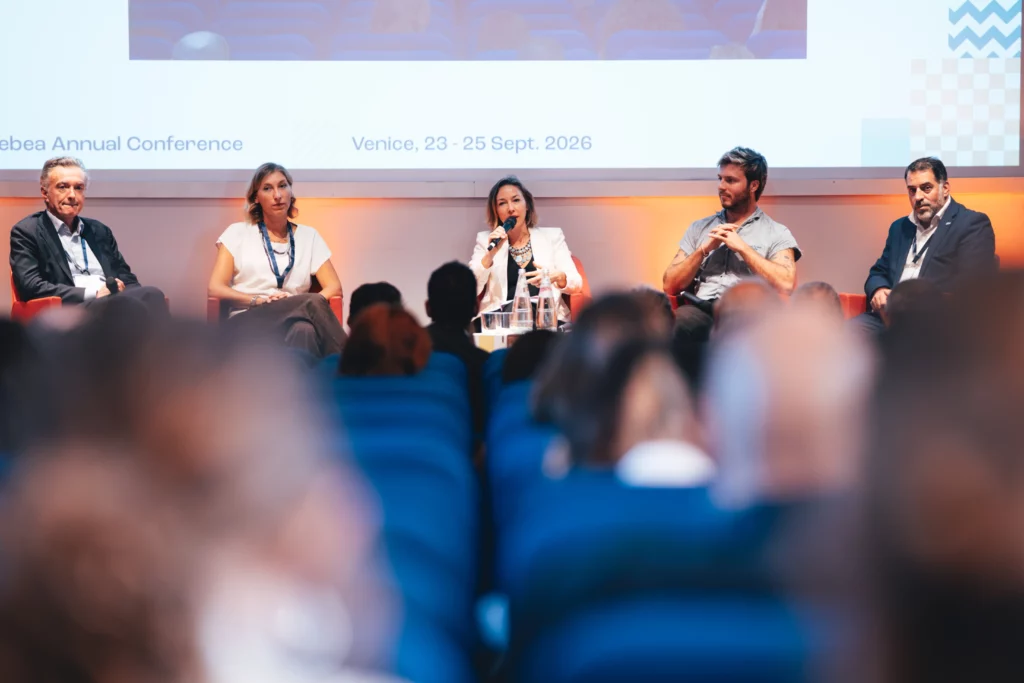
The panel showed how FEBEA brings together different levels of the European ecosystem, connecting the practical experience of its members with European policymaking and the wider social-economy movement. Dauriat offered the perspective of the European Commission, highlighting the role of EU policies and financial instruments in creating an enabling environment for ethical finance. Rusconi brought to light the experience of France Active and its work with FEBEA and other FEBEA members, illustrating how collaboration within the network can help identify common needs, strengthen advocacy and shape financial instruments that better serve ethical finance actors. De Heusch situated FEBEA’s work within the broader European social economy, emphasising how closer cooperation and shared advocacy can strengthen the impact of both movements. Finally, Vrettos illustrated how partnerships between specialised organisations and financial actors can translate shared objectives into practical financial tools, as in the case of community-led renewable energy. Together, their contributions demonstrated the value of connecting policy, advocacy, social-economy networks and financial expertise to strengthen the ecosystem supporting ethical finance across Europe.
The central conclusion of the panel was that ethical finance is not an end in itself. It enables new approaches to energy, housing, employment, care, agriculture and local development. To perform that role, financiers must remain connected to the social movements, policymakers and organisations leading those transformations.
Closing the conference as FEBEA’s newly elected President, Panagiotis Tournavitis drew on his experience at the Cooperative Bank of Karditsa, a locally rooted institution that continued lending through Greece’s sovereign-debt crisis, capital controls, the pandemic and devastating floods.
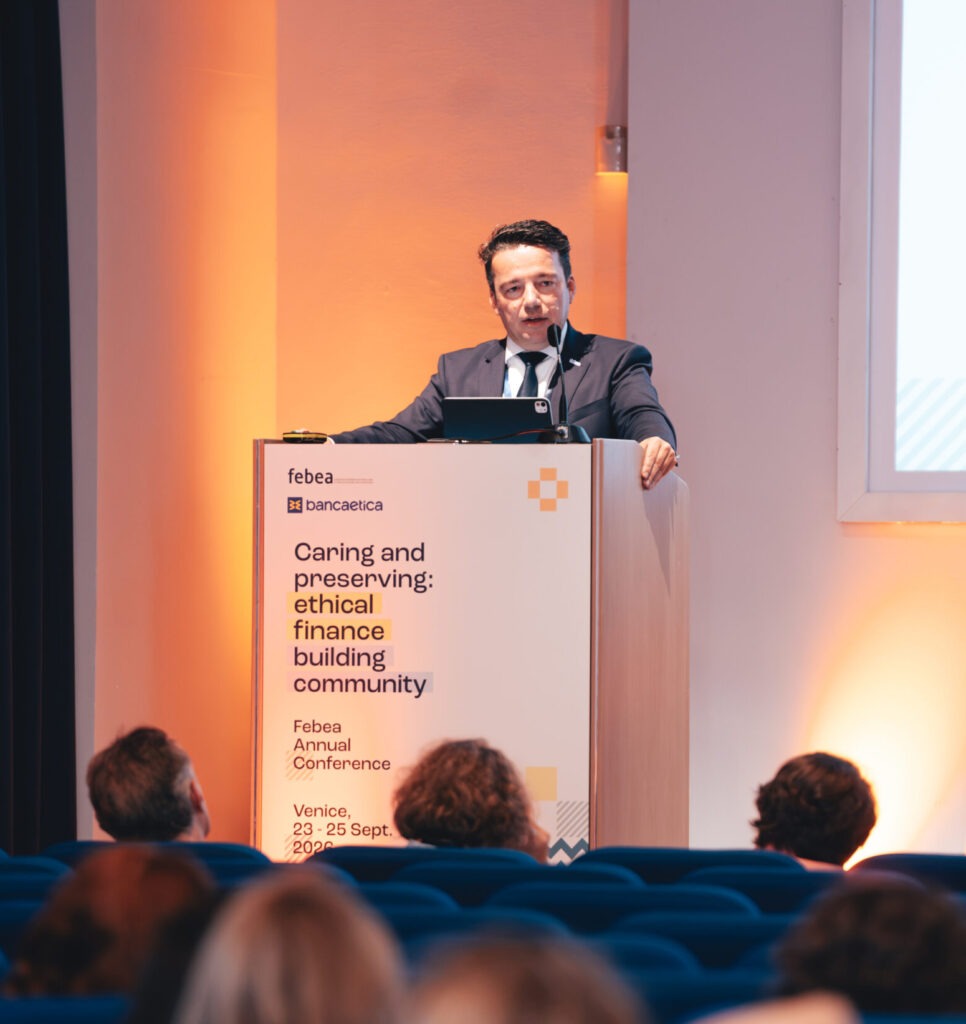
His address captured the distinctive approach of ethical finance: “We are the people who believe that money is a tool and not a master.” He argued that conventional finance often sees only risk, small transactions and low margins when considering a cooperative, refugee-led enterprise, energy community or social-housing project. Ethical financiers see what those projects make possible for a community. “It is not that we are nicer than other banks. It is that we measure differently. We count what matters. And because we count what matters, we finance what matters.”
His final invitation also expressed the purpose of FEBEA’s next chapter: “Let us go home and keep building bridges in a world that is busy building walls”.
Twenty-five years after its creation, FEBEA leaves Venice with new leadership but the same founding conviction: ethical-finance institutions become stronger when they resist isolation, pool their capabilities and act as part of a wider movement.
Founded in Italy in 1999, Banca Etica is a cooperative bank dedicated exclusively to financing projects with positive social, cultural and environmental value. A founding member of FEBEA and the Global Alliance for Banking on Values, it operates through transparent lending and participatory governance based on the principle of “one person, one vote”. The Banca Etica Group supports the social economy, ecological transition, international cooperation and community welfare in Italy and Spain, while excluding sectors such as weapons, fossil fuels and speculative finance.
A huge thank you to Banca Etica for co-organising this year’s FEBEA Conference with us and for welcoming the FEBEA community to Italy. From the first moment to the final conversation, your generosity, collaboration and commitment helped make the conference what it was: a space for meaningful encounters, bold ideas and connections that will continue well beyond these few days. We’re truly grateful to have shared this moment with you and to have brought our community together on your home ground.
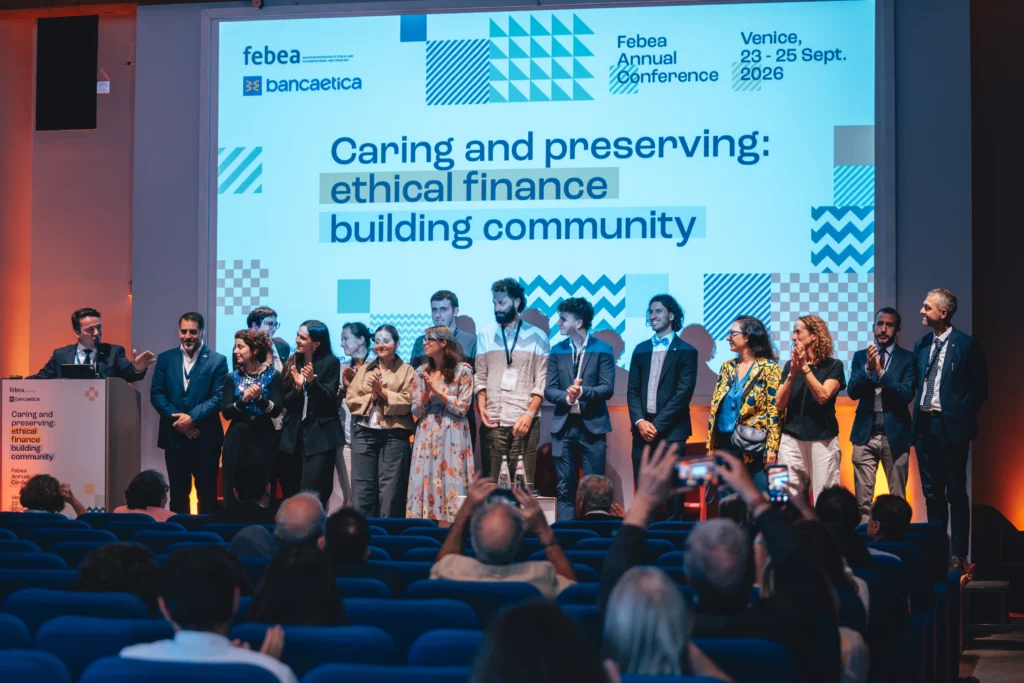
A big thank you as well to our conference sponsors: the European Investment Fund (EIF), Coopfond and Etica Funds, and also to FEBEA members La Nef, Cooperative Bank of Karditsa,GLS Bank and Gruppo Cassa Centrale. Your support reflects the collaborative spirit that underpins this conference and the wider movement for a more sustainable, inclusive and ethical financial system.
Thank you to everyone who contributed to making this year’s gathering such a meaningful moment for our community.