Share this post:
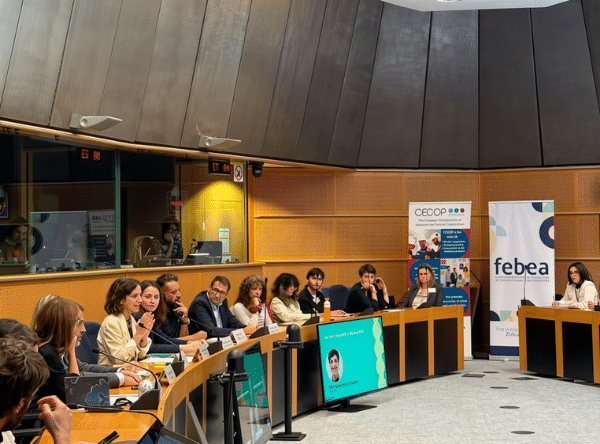
On 13 October, FEBEA and the European Confederation of Industrial and Service Cooperatives (CECOP) brought policymakers, financial institutions and social economy representatives together at the European Parliament to explore how InvestEU has supported cooperatives and social economy enterprises, and what its successor under the European Competitiveness Fund (ECF) must deliver.
Hosted by MEP Benedetta Scuderi (Greens/EFA), shadow rapporteur for the ECF in the European Parliament’s ITRE Committee, the event, “Can the new MFF be a catalyst for the social economy? The multiplier effect of InvestEU,” took place at a decisive moment for the EU’s 2028–2034 Multiannual Financial Framework (MFF).
The objective was clear: to demonstrate, through concrete examples from the field, why Europe must preserve and strengthen the financial infrastructure that enables social economy organisations to grow, create quality jobs and deliver lasting benefits to their communities.
Opening the event, Francesca Montalti, Vice-President of CECOP, highlighted the scale of the cooperative movement, whose members represent 43,000 cooperatives employing 1.2 million people.
Cooperatives need appropriate financial instruments to sustain their growth and continuity. They do more than preserve jobs: they keep value, skills and decision-making in European territories, while contributing to inclusive transitions, industrialisation and democracy.
MEP Benedetta Scuderi reinforced this message, underlining that competitiveness must go hand in hand with resilience, quality jobs and quality of life. As the EU shapes its next financial framework, continuity and predictability will be essential to ensure that social economy enterprises can access the resources they need.
The challenge is not simply to mobilise investment, but to ensure that finance reaches organisations delivering public benefit and responding to local needs.
The event brought together practitioners from France, Spain and Italy to show how EU-backed financial instruments translate into concrete economic and social outcomes.
Alessandro Viola of Cooperazione Finanza Impresa (CFI) highlighted the role of European guarantees in supporting cooperative finance and worker buyouts. CFI’s experience shows how long-term financial support helps preserve businesses, sustain employment and strengthen cooperative ownership, reinforcing the need for accessible and continuous EU-backed instruments.
Viola’s presentation also illustrated how European guarantees have strengthened CFI’s financing capacity. Across the five-year EaSI guarantee period from 2014 to 2019 and the subsequent five-year period from 2019 to 2024, which included InvestEU, CFI’s approved deals increased from €37.87 million to €63.63 million, while equity interventions rose from €9.32 million to €13.94 million. These figures illustrate the role that European financial instruments can play in expanding support for cooperative enterprises.
Aurélien Hiraux, Director of Investment at the FEBEA member SOCODEN, explained how EIF guarantees through EaSI and InvestEU have helped reduce risk and strengthen SOCODEN’s capacity to finance cooperatives. Between 2019 and 2025, SOCODEN signed a €17 million agreement with the EIF, representing around 20% of its current outstanding resources. These guarantees help SOCODEN structure financing packages for cooperatives, supporting both their day-to-day cash flow and longer-term development. During the period discussed, the cooperative movement supported the creation of 10,000 jobs.
Karim Sabni, President of the FEBEA member Coop57, offered another striking example of this multiplier effect. With an EIF-backed guarantee of €4 million, Coop57 has been able to mobilise €53 million in loans and support more than 6,300 jobs.
For every euro in guarantees, Coop57 mobilises €13 in loans.
These loans support a diverse range of activities, including housing, energy, agriculture, education, healthcare, care services and social inclusion. They demonstrate the importance of combining European guarantees with locally rooted finance and citizens’ savings.
As Karim Sabni explained, “A European guarantee does not stay in Brussels: it becomes wealth and employment in local communities.”
Together, these examples show that the multiplier effect is not measured in capital alone, but also in jobs created, services delivered and communities strengthened. The social economy is not a niche sector; it is a productive part of Europe’s economy, addressing challenges that conventional financial analysis can struggle to capture.
Georgiana Buturoiu, Head of the Microfinance, Alternative Lenders and Fintech Division at the European Investment Fund (EIF), explained how EU financial instruments help address the barriers facing social enterprises and vulnerable entrepreneurs.
Many social enterprises struggle to access conventional finance because they are perceived as too risky, too large for microfinance or too small for institutional investors.
Through portfolio guarantees, the EIF enables financial intermediaries to take on more risk and reach underserved businesses. Capacity-building and equity or quasi-equity support can also help organisations strengthen their infrastructure and develop their activities.
InvestEU supports initiatives across healthcare, housing, sustainability, social assistance and other areas where financing needs remain substantial. Maintaining this support is therefore not only about financing enterprises; it is about enabling inclusive economic development.
Buturoiu also emphasised the importance of measuring and communicating impact. Strong evidence of what these instruments deliver is essential to inform policymakers and build the case for their continuation.
Despite this evidence, the proposed architecture for the next MFF raises important concerns.
As highlighted in FEBEA’s position on the Social Investment and Skills Window in the new MFF, the current proposals do not provide a direct successor to the dedicated Social Investment and Skills Window. Without a clear framework, specialised social finance intermediaries risk losing access to an essential mechanism for supporting cooperatives, social enterprises and microfinance.
Throughout the event, speakers converged on three priorities: continuity, easier access and proportionality.
First, continuity and predictability are essential. Financial intermediaries need stable, long-term guarantees to plan their activities and support enterprises through start-up, development, worker buyouts and periods of economic uncertainty.
Second, access must be improved. Administrative and reporting requirements should not prevent smaller intermediaries and cooperatives from benefiting from EU support. These organisations do far more than provide capital: they offer legal and financial guidance, training and intensive support, particularly during complex processes such as worker buyouts. Excessive administrative burdens risk diverting resources away from this essential work.
Third, requirements must be proportionate to the size and capacity of the organisations involved. A framework designed to support the social economy must reflect the diversity of its financial intermediaries and ensure that smaller, locally rooted organisations can participate.
As the EU designs its next financial framework, it must also explicitly recognise the social economy’s contribution to competitiveness, resilience, territorial cohesion and social objectives.
For FEBEA and CECOP, the priority is clear: maintain, reinforce and adequately fund a dedicated Social Investment and Skills Window, while making it simpler and more proportionate to access.
Closing the event, FEBEA Secretary General Daniel Sorrosal returned to the evidence presented throughout the discussion: the examples speak for themselves. InvestEU has demonstrated that European guarantees can unlock financing, support cooperative development and generate tangible benefits for communities.
The model works because EU guarantees enable specialised financial intermediaries to do what they do best: mobilise additional resources, understand local needs and reach enterprises that conventional finance often overlooks.
The next MFF is an opportunity to build on this proven model. But without continuity, sufficient resources and accessible rules, Europe risks weakening the very financial ecosystem that makes social investment possible.
The question is not whether Europe can afford to maintain these instruments, but whether it can afford to lose them.
Investing in the social economy means investing in quality jobs, essential services, resilient local economies and a more inclusive European future. The next EU budget must recognise this contribution and give social investment the financial infrastructure it needs to grow.