Share this post:
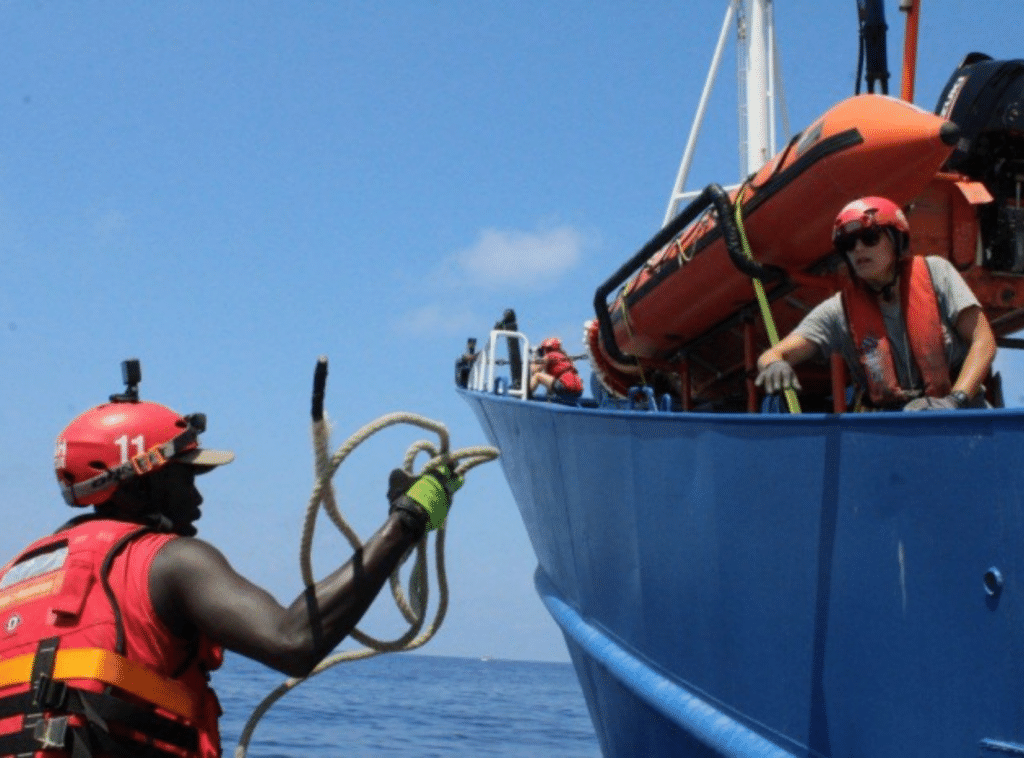
On a grey Friday in Syracuse, members of the FEBEA team and some of our member organisations boarded the Humanity 1, SOS Humanity’s rescue ship. The crew welcomed us at the port and explained what happens when a vessel encounters people in distress in the Mediterranean: how a rescue is organised, how medical care is provided and what happens during the days spent sailing towards a place of safety.
They also showed us the places where something harder to measure begins: the rebuilding of trust. We saw a small children’s room full of drawings, with a Montessori-style bookshelf, one that helps kids become autonomous. We shared the food the crew prepares for the people they rescue. These are simple but deeply meaningful gestures: after fear, violence and uncertainty, receiving care is also a way to restore dignity.
The visit reminded us of something fundamental. Humanitarian emergencies do not disappear because the political debate shifts, because they no longer make the headlines or because budgets are reduced. Ethical finance cannot look away from what is urgent.
In 2025, at least 2,185 people died or went missing in the Mediterranean, according to the International Organization for Migration (IOM). Another 1,214 were recorded on the Atlantic route from West Africa towards the Canary Islands. The real figure is likely to be higher: some disappearances cannot be verified or are never documented.
More recent data shows that fewer arrivals do not necessarily mean safer journeys. In September 2026, IOM reported that sea arrivals in Europe had fallen by 39% compared with the same period the previous year, while deaths on the Central Mediterranean route had increased. On the Atlantic and Western Mediterranean routes towards Spain, the organisation had recorded 879 deaths.
On board the Humanity 1, the crew told us about people arriving from different countries, including Sudan, and about the violence many have experienced during their journeys. They also explained the difficulties of providing care while the ship sails towards the port of disembarkation assigned by the Italian authorities.
SOS Humanity denounces the assignment of distant ports and administrative measures against civilian rescue ships, which it says prolong journeys and hinder operations. The organisation is part of Justice Fleet, an alliance of search and rescue organisations that combines legal, political and public action to defend human rights at sea.
The Humanity 1 we visited in Syracuse is part of a response sustained by professional expertise, civic commitment and financial resources. To expand this response, SOS Humanity has developed a second ship, the Humanity 2, intended for search and rescue, medical care and the documentation of human rights violations in the Central Mediterranean.
The FEBEA member GLS Bank is a financing partner for the project. In addition, through GLS Crowd, a crowdfunding platform initiated by the bank, SOS Humanity raised €636,000 to contribute to the purchase, conversion and initial operations of the ship. Its financing combines crowd investment, a bank loan and donations.
This example shows how financial tools can mobilise a community to respond to a concrete need. It also raises an important question: an investment or a loan is not a donation. Financial instruments must be designed with the costs, risks and capacity of humanitarian organisations in mind, so that finance truly serves their mission.
In Spain, Fiare Banca Etica supports Salvamento Marítimo Humanitario, the organisation behind the Aita Mari rescue ship. The association began its work in 2015 on the Greek island of Chios, responding to the needs of people crossing the Aegean Sea, and later extended its work to the Central Mediterranean.
Originally a tuna fishing vessel destined for scrap, the Aita Mari was purchased in 2018 and adapted to save lives. Its crowdfunding campaigns help cover essential costs such as fuel, food and crew salaries, as well as improvements to make the ship better suited to rescue missions.
Salvamento Marítimo Humanitario is a member and client of Fiare and, according to the bank, has received financing for its rescue and humanitarian activities. This support is complemented by public mobilisation: the campaign for its 2026 missions was promoted through Fiare’s channel on the crowdfunding platform Goteo.
The relationship goes beyond a financial transaction: it connects the savings and participation of a community with an organisation that needs resources to sustain its missions and continue defending the rights of people on the move.
In France, La Nef supports SOS MEDITERRANEE France, a European civil organisation working on rescue in the Central Mediterranean. Its ship, the Ocean Viking, is part of a response sustained by a broad community of donors and partner organisations.
The partnership with La Nef uses a different mechanism from a loan: Coopinage, a sponsorship system through which the bank commits to making donations to the organizations chosen by the sponsoring customers and new sponsored customers. When a new customer opens a savings product using another customer’s referral code, La Nef makes two €20 donations to the organisations chosen by the two participants. SOS MEDITERRANEE is among the possible beneficiaries now.
It is a way of turning a common banking practice, recommending a bank to new customers, into financial support for organisations working for social change. Once again, the question is not only how much money moves, but where it goes and whom it serves.
During our visit to the Humanity 1, Till Rummenhohl, from SOS Humanity’s management team, spoke to us about declining contributions and the pressure this places on the organisation’s budget. Fewer resources can mean less operational capacity at precisely the time when the need for rescue continues.
Ethical finance can help sustain this work through responsible loans, crowd investment, donations and ongoing support. But it must not replace the obligations of states or turn the protection of life into a responsibility that depends exclusively on private generosity.
Our role is also to ask what kind of finance humanitarian organisations need: finance that is accessible, transparent and adapted to their reality; that does not impose an extractive logic or put financial returns before people.
And, as civil society, we have a responsibility to keep speaking out, denouncing abuses and demanding accountability. The defence of human rights cannot depend on the political climate or on the issue of the moment.
From Syracuse, the message we took with us is simple: when lives are at risk, what is urgent does not change. Refusing to look away and putting resources at the service of life is also a financial choice.